What moved in markets on Wednesday 25 November 2026, why it moved and what comes next — summarised from the publishers credited below.
Market snapshot
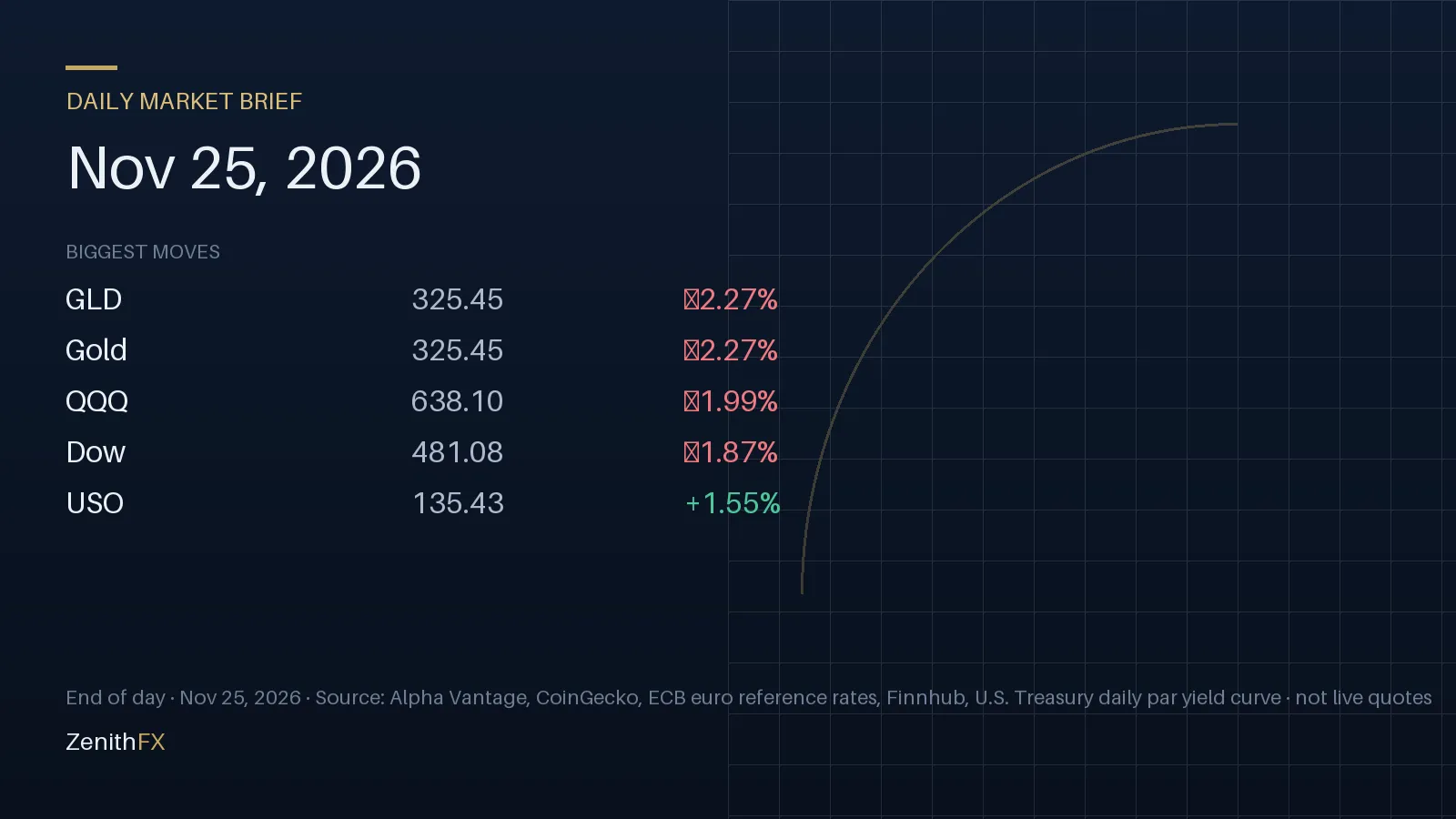
GLD 325.45 (-2.27%) · Gold 325.45 (-2.27%) · BTC/USD 58,308.00 (-2.08%) · QQQ 638.10 (-1.99%).
Mixed sources: end-of-day reference values as of 2026-11-25 and quotes delayed by up to 1440 minutes; nothing here is a real-time quote.
What moved
- Japan's Average Loan and Discount Rates for September Released (reported by Bank of Japan — what's new)
- Japan Services Producer Price Index Released for October (reported by Bank of Japan — what's new)
- Metals Stabilise After Sharp Selloff as Markets Brace for US Inflation Data (reported by Bloomberg Markets and Barron's)
Why it moved
Japan's Average Loan and Discount Rates for September Released. Japanese lending rate data touches the yen, Japanese government bonds, and carry-trade-sensitive assets such as emerging-market currencies and risk equities; historically, rising Japanese borrowing costs have prompted unwinding of yen-funded positions across global markets.
Japan Services Producer Price Index Released for October. The SPPI feeds directly into Bank of Japan rate expectations, which in turn drive moves in the Japanese yen, Japanese government bonds and yen-linked currency pairs. A trend change in services inflation typically transmits to these instruments faster than it reaches consumer-level data.
Metals Stabilise After Sharp Selloff as Markets Brace for US Inflation Data. Metals prices are sensitive to interest rate expectations because higher borrowing costs increase the cost of holding commodities and can dampen industrial demand; commodity-linked currencies like the Australian dollar tend to move in a similar direction, so both markets are exposed to the same inflation catalyst.
Key events
- Average Contract Interest Rates on Loans and Discounts (Sept.) — official source: boj.or.jp
- Services Producer Price Index (Oct.) — official source: boj.or.jp
Markets to watch
- Copper, AUD/USD — linked to: Metals Stabilise After Sharp Selloff as Markets Brace for US Inflation Data
- GLD — among the larger moves in the latest reference snapshot
- Gold — among the larger moves in the latest reference snapshot
- BTC/USD — among the larger moves in the latest reference snapshot
- QQQ — among the larger moves in the latest reference snapshot
Educational takeaway
The gap between a central bank's policy rate and the average rate borrowers actually pay — known as the pass-through — reveals how effectively monetary policy is transmitting into the real economy.
Join the discussion
How closely are you watching Japan's lending-rate trends as a signal for potential yen carry trade unwinding, and what threshold would prompt you to adjust your positioning? Discuss it in today's Market Huddle.
Sources
ZenithFX summarises reporting and official releases from the publishers below; it did not report these events itself.
- Bank of Japan — what's new: Average Contract Interest Rates on Loans and Discounts (Sept.)
- Bank of Japan — what's new: Services Producer Price Index (Oct.)
- Bloomberg Markets: Metals Mixed After Major Selloff as Traders Await US Inflation
- Barron's: Stubborn Inflation Could Pose a Bigger Threat to Markets Than AI Worries
- FXStreet: Forex Today: Australian inflation leads a busy pre-Thanksgiving US docket
- FOREX.com: AUD/USD: Bullish Signals Emerge Ahead of Inflation Showdown
- NAI500: Inflation Erodes Purchasing Power, Trump’s Remarks Trigger Market Concerns
Explain simply — 2 terms in this article, in plain language
- Policy rate
- The short-term interest rate a central bank sets to steer borrowing costs and inflation.
- Leverage
- Controlling a position larger than the money you put down. It magnifies gains and losses by the same factor. Leverage changes the size of mistakes, not the odds of being right.
Editorial definitions, not advice. All plain-language terms
Discuss this article
The ZenithFX desk opened a moderated discussion on this article.